Sublocade vs. Methadone: Partial vs. Full Opioid Agonist
Methadone has been used for opioid use disorder for decades. Sublocade is newer. Both are proven treatments, but they differ in how they work and where you get them.
Written by Benjamin Zohar, NCACIP · Edited by Ezra Zohar, M.S. Ed. · Published · Updated · Medically reviewed by Brandon McNally, RN on
Quick answer
Methadone is a full opioid agonist. For opioid use disorder, it is dispensed at federally certified opioid treatment programs (OTPs), usually as a daily oral dose. Sublocade is a partial agonist given as a monthly injection in a certified healthcare setting.
- Methadone fully activates opioid receptors; buprenorphine only partly.
- Methadone for OUD comes only from an OTP.
- Methadone may suit people with very high opioid tolerance.
- Both reduce overdose death risk when continued, per NIDA.
Sublocade vs. Methadone at a glance
| Feature | Sublocade | Methadone |
|---|---|---|
| How it works | Partial agonist | Full agonist |
| Form | Monthly injection | Daily oral liquid or tablet |
| Where you get it | Certified healthcare setting | Opioid treatment program (OTP) |
| Rules | FDA safety program (REMS) | Federal rules under 42 CFR Part 8 |
| Breathing suppression | Ceiling effect, lower risk alone | No ceiling; dose-dependent risk |
| Heart rhythm (QT) | Less common concern | Monitoring may be needed |
Based on current FDA prescribing information. Labels change; your prescriber follows the latest version.
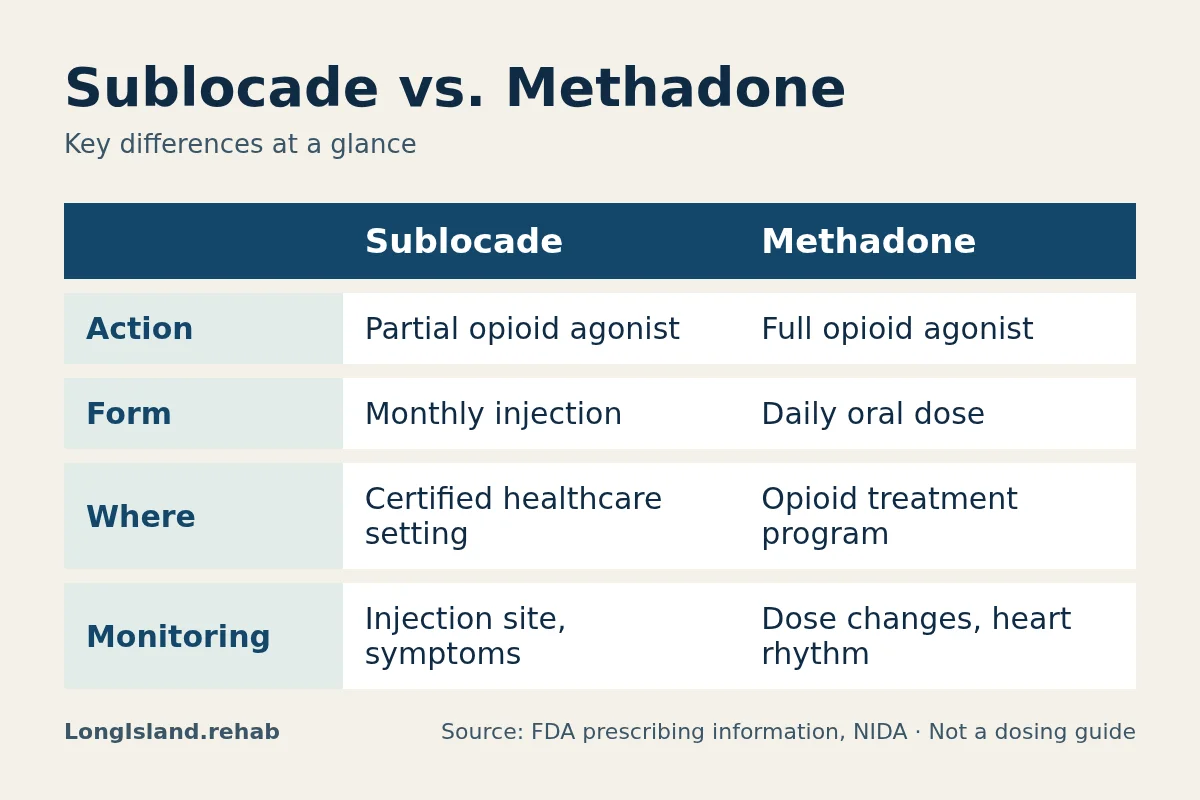
Full vs. partial agonist
Methadone activates opioid receptors fully. That can help people with high tolerance, including fentanyl exposure. It also means dosing must be adjusted carefully.
Buprenorphine has a ceiling effect. Beyond a point, more does not increase its effect much. This lowers, but does not remove, overdose risk.
Access on Long Island
Methadone requires regular visits to an OTP, especially early on. Federal rules updated in 2024 allow more take-home doses for stable patients, at the program's discretion.
Sublocade needs monthly visits to a certified setting. Availability varies across Nassau and Suffolk counties.
Switching between them
Moving from methadone to buprenorphine can trigger withdrawal if timed poorly. Clinicians often lower the methadone dose and wait before starting buprenorphine. This should always be medically guided.
Side effects and safety
- Methadone has no ceiling effect on breathing. Doses are raised slowly, and the first weeks carry the highest overdose risk (NIH StatPearls).
- Methadone can affect heart rhythm (QT prolongation). Some people need an ECG, especially at higher doses or with other medicines.
- Both medicines are dangerous when combined with benzodiazepines, alcohol or other sedatives.
- Sublocade has a boxed warning about serious harm if it enters a vein, and is only given in certified settings.
Questions about switching to ask a clinician
Switching between these medications should only be planned with a prescriber. These questions can help that conversation.
- Would I need to lower my methadone dose before trying buprenorphine?
- How would the clinic manage withdrawal during the change?
- If buprenorphine does not control my cravings, can I return to methadone?
- Would my take-home methadone schedule change during a switch?
Insurance and access
- Methadone for opioid use disorder is only dispensed at certified opioid treatment programs (OTPs). New York lists certified programs through OASAS.
- Ask an OTP about intake hours, how often you must visit at first, and its take-home policy under the 2024 federal rules.
- Medicaid in New York covers methadone treatment at OTPs. Commercial plan coverage varies — ask your plan directly.
Finding care on Long Island
Across Nassau and Suffolk counties, office-based buprenorphine prescribers are more common than clinics offering injectables. Methadone for opioid use disorder is only available through certified opioid treatment programs.
- Ask directly: "Do you offer Sublocade and Methadone, and do you keep them in stock?"
- First visit: ask what the assessment includes and how soon medication can start.
- Insurance: call the number on your card and ask about prior authorization before the first dose.
- Scheduling: ask how often visits happen in the first month and later.
- Continuity: ask who to call between visits, and what happens if you move or change plans.
New York State lists certified programs through the OASAS provider directory.
Appointment checklist
Bring these to your first visit:
- A list of every medicine and supplement you take, including doses.
- Your recent substance use, including the last time you used opioids.
- Your insurance card and any prior authorization paperwork.
- Questions about the schedule, side effects and what to do if you miss a visit.
- Contact details for any other doctors involved in your care.
Evidence and uncertainty
FDA-approved medications for opioid use disorder are strongly supported by research, according to NIDA. Direct head-to-head trials between specific long-acting products are limited. Choices depend on history, goals, other health conditions and access.
Frequently Asked Questions
Get answers to common questions about our 24/7 crisis helpline and addiction support services.
Still have questions? Our crisis counselors are available 24/7.
Call 844-338-6969Sources and editorial information
- FDA: Sublocade (buprenorphine extended-release) prescribing information
- NIH StatPearls: Methadone
- eCFR: 42 CFR Part 8 — Medications for the Treatment of Opioid Use Disorder
- NIDA: Medications to Treat Opioid Use Disorder research report
- NYS OASAS: Addiction medications
Written by Benjamin Zohar, NCACIP, and edited by Ezra Zohar, M.S. Ed. Medically reviewed by Brandon McNally, RN. See our editorial guidelines.
Medical disclaimer: This article is for education only and is not medical advice. Long Island Rehab Helpline is an independent treatment-navigation resource, not a treatment provider. Talk with a licensed prescriber about your situation.
Questions about medication options?
If you would like help finding licensed providers on Long Island that offer these medications, you can explore MAT options or talk with a treatment navigator at (844) 338-6969.