Crack vs. Powder Cocaine: What's the Difference?
Key Takeaways
- • Crack and cocaine contain the same active drug — they differ in chemical form and how they are used.
- • Crack is smoked and acts in seconds; powder cocaine is typically snorted and acts in 1–3 minutes.
- • Both are highly addictive; crack's rapid, short high tends to drive faster dependence.
- • Treatment is primarily behavioral (CBT, contingency management) — no FDA-approved medication exists for cocaine use disorder.
Crack and cocaine are two forms of the same underlying drug, but the differences between them — in how they are used, how fast they act, and how quickly dependence develops — have real consequences for health, addiction risk, and recovery.
People often use the words "crack" and "cocaine" as if they describe two completely different drugs. In reality, they share the same active compound. What separates them is chemistry, form, and route of use — and those differences matter enormously when it comes to how addictive each is and how dangerous misuse becomes. This guide explains the differences in plain terms, what each does to the body and mind, and what treatment looks like for cocaine and crack addiction.
If you or someone you love is struggling with crack or cocaine, help is available. Long Island Rehab Helpline provides confidential treatment navigation and placement support for individuals and families across Long Island and the greater New York area.
Crack vs. Cocaine: What's the Difference?
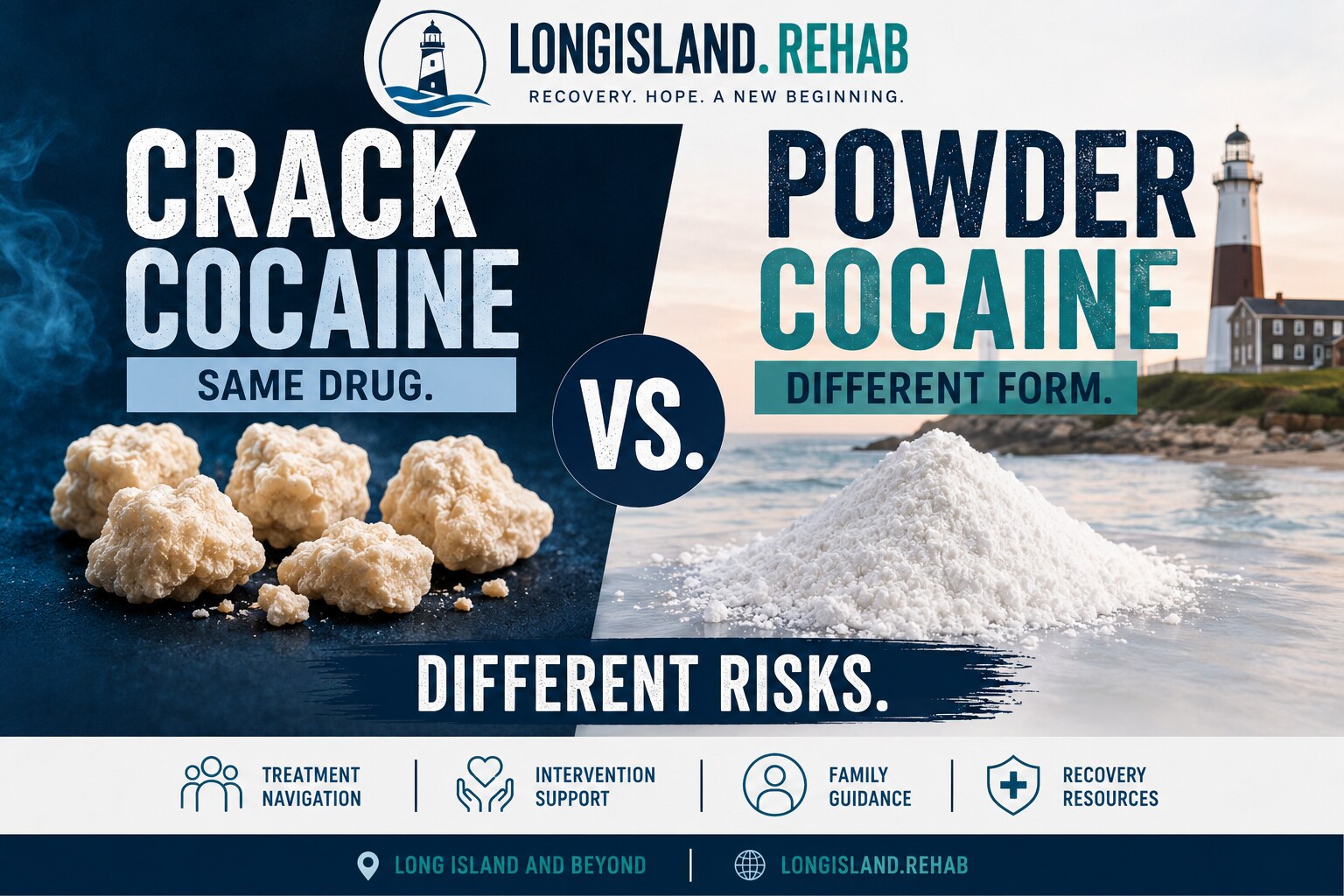
Both crack and powder cocaine are derived from the coca plant and contain the same active stimulant. The core distinction is the chemical form the drug takes, which determines how it is used and how the body absorbs it.
Powder cocaine is cocaine hydrochloride — a salt form that dissolves in water. It is typically snorted (insufflated) or, less commonly, dissolved and injected.
Crack cocaine is the freebase form of cocaine, processed into small solid "rocks" that can be smoked. The name "crack" comes from the crackling sound the rocks make when heated. Because it is smoked, crack reaches the brain almost immediately.
The practical takeaway: it is the same drug delivered two different ways, and the delivery method is what drives most of the differences in speed, intensity, and addiction potential described below. This article explains the chemical distinction at an educational level only; it does not describe how either substance is produced.
Crack vs. Cocaine Comparison Table
| Characteristic | Powder Cocaine | Crack Cocaine |
|---|---|---|
| Chemical form | Cocaine hydrochloride (salt) | Freebase cocaine (solid "rock") |
| Typical route | Snorted; sometimes injected | Smoked |
| Onset of effects | 1–3 minutes (snorted) | Seconds (smoked) |
| Duration of high | 15–30 minutes | 5–10 minutes |
| Intensity | Intense but slower onset | More immediate, intense rush |
| Addiction potential | High | Very high (faster onset, shorter high, more frequent use) |
| Drug classification | Schedule II controlled substance | Schedule II controlled substance |
How the Effects Differ

Because crack is smoked and reaches the brain within seconds, it produces a faster, more intense high than snorted powder cocaine — but that high also fades more quickly, often within minutes. Powder cocaine takes a little longer to take effect and lasts somewhat longer.
This difference in timing is central to why crack is generally considered to carry a higher addiction risk. The rapid, intense, short-lived high tends to drive a cycle of repeated use to chase the initial rush, which reinforces compulsive patterns faster than the slower curve of snorted cocaine.
Both forms produce the same general stimulant effects, including:
- Euphoria and a surge of energy
- Increased heart rate and blood pressure
- Heightened alertness and talkativeness
- Reduced appetite
- Anxiety, irritability, and paranoia, especially at higher doses or during a "crash"
Health Risks of Crack and Cocaine
Both forms of cocaine carry serious, potentially fatal health risks. Because they are the same drug, many of these overlap, though the route of use adds form-specific dangers.
Shared cardiovascular and neurological risks
- Heart attack: Cocaine sharply raises heart rate and blood pressure and can trigger cardiac events even in young, healthy people.
- Stroke and seizures: Elevated blood pressure and vasoconstriction increase the risk of both.
- Cardiac arrhythmias: Irregular heartbeats that can be fatal.
- Overdose: Risk rises with higher doses and when cocaine is combined with alcohol or opioids.
- Psychological effects: Paranoia, panic, aggression, and stimulant-induced psychosis.
Route-specific risks
- Snorting (powder): Damage to the nasal passages, including loss of smell and, with chronic use, perforation of the nasal septum.
- Smoking (crack): Lung damage, chronic cough, and respiratory problems sometimes described as "crack lung."
- Injecting (either, if dissolved): Infection risk, vein damage, and bloodborne disease transmission.
For broader public-health context on substance use risk and screening, the World Health Organization's substance-use resources and the National Institute on Drug Abuse cocaine DrugFacts offer evidence-based background for families and professionals.
Which Is More Addictive — Crack or Cocaine?
Because crack and cocaine are the same active drug, neither is inherently "stronger" at the molecular level. The difference in addiction risk comes from how they are used. Smoking crack delivers the drug to the brain almost instantly and produces a brief, intense high, which tends to drive more frequent use and faster development of compulsive patterns. Snorted powder cocaine has a slower onset and longer duration.
For this reason, crack is often associated with a higher risk of rapid dependence. That said, both forms are highly addictive, and powder cocaine addiction is serious and common. Addiction risk also depends heavily on individual factors — frequency of use, genetics, mental health, and environment — not just the form of the drug.
The Crack vs. Powder Cocaine Sentencing Disparity
One of the most searched and historically significant aspects of the crack-versus-cocaine question is legal, not pharmacological. For decades, U.S. federal law punished crack cocaine offenses far more harshly than powder cocaine offenses, despite the two being the same drug.
Under the Anti-Drug Abuse Act of 1986, the sentencing ratio was 100:1 — meaning it took 100 times as much powder cocaine as crack cocaine to trigger the same mandatory minimum federal sentence. This disparity drew sustained criticism for its disproportionate impact on Black communities, since crack offenses were prosecuted more heavily.
The Fair Sentencing Act of 2010 reduced the disparity from 100:1 to 18:1, and the First Step Act of 2018 made those reductions retroactive, allowing some individuals sentenced under the old ratio to seek reduced sentences. The disparity has narrowed but, at the federal level, has not been fully eliminated. This history is important context for understanding why crack and cocaine — chemically the same drug — have been treated so differently under the law.
Treatment for Crack and Cocaine Addiction

There are currently no FDA-approved medications specifically for cocaine or crack use disorder, so treatment centers on behavioral and psychosocial approaches, often combined with medically supervised support during early withdrawal. Evidence-based options include:
- Medically supervised detox: Support and monitoring during the acute "crash" and early withdrawal period.
- Cognitive Behavioral Therapy (CBT): Identifies triggers and builds coping strategies to prevent relapse.
- Contingency Management: Uses structured incentives to reinforce abstinence — one of the better-supported approaches for stimulant use disorder.
- The Matrix Model: A structured outpatient program designed for stimulant use disorders.
- Residential or intensive outpatient treatment: Higher levels of care for more severe addiction.
- Peer support: 12-step programs (such as Cocaine Anonymous) and SMART Recovery.
Withdrawal from crack or cocaine is rarely physically dangerous in the way some other withdrawals can be, but the psychological symptoms — intense cravings, depression, fatigue, and anhedonia — are significant and are a major driver of relapse. Professional support meaningfully improves outcomes.
Getting Help on Long Island and in New York
If crack or cocaine use is affecting you or someone you love, you don't have to navigate the treatment system alone. The Long Island Rehab Helpline offers confidential, no-pressure help understanding your options and connecting to the right level of care — from detox to residential to outpatient programs — across Long Island, Nassau County, Suffolk County, and the greater New York City area.
Our team helps individuals and families understand what treatment involves, what insurance may cover, and how to take the next step. Reaching out is free and confidential.
Frequently Asked Questions
Conclusion
Crack and cocaine are two forms of the same drug, distinguished mainly by chemical form and route of use — and those differences shape everything from how fast the high hits to how quickly addiction can take hold. Both carry severe health risks, both are highly addictive, and both are treatable. Understanding the real differences cuts through the confusion and the stigma, and it can be the first step toward getting help.
Related Resources
Related Articles
Continue learning about stimulant use disorders and related topics covered on Long Island Rehab Helpline & Crisis Intervention.
This article is for educational and informational purposes and does not constitute medical advice. If you are concerned about cocaine or crack use, consult a qualified healthcare professional.
Medical References & Sources
This page contains information sourced from peer-reviewed medical literature, federal health agencies, and accredited medical institutions to ensure accuracy and compliance with E-E-A-T (Experience, Expertise, Authoritativeness, and Trustworthiness) standards.
- National Institute on Drug Abuse (NIDA). "Cocaine DrugFacts." NIH. Available at: https://nida.nih.gov/publications/drugfacts/cocaine
- National Institute on Drug Abuse (NIDA). "Cocaine Research Report." NIH. Available at: https://nida.nih.gov/publications/research-reports/cocaine
- Hatsukami, D.K., & Fischman, M.W.. "Crack Cocaine and Cocaine Hydrochloride: Are the Differences Myth or Reality?." JAMA, 1996 DOI: 10.1001/jama.1996.03540190072039. Available at: https://doi.org/10.1001/jama.1996.03540190072039
- Centers for Disease Control and Prevention (CDC). "Cocaine Overdose Data." CDC WONDER. Available at: https://www.cdc.gov/overdose-prevention/data-research/facts-stats/stimulant-overdose-data.html
- Drug Enforcement Administration (DEA). "Cocaine Drug Fact Sheet." DEA. Available at: https://www.dea.gov/factsheets/cocaine
- Substance Abuse and Mental Health Services Administration (SAMHSA). "Treatment for Stimulant Use Disorders (TIP 33)." SAMHSA. Available at: https://store.samhsa.gov/product/treatment-stimulant-use-disorders/pep21-02-01-004
Medical Disclaimer
The information provided on this page is for educational purposes only and should not be considered medical advice. This page does not provide medical diagnoses, treatment prescriptions, or clinical recommendations. Always consult with qualified healthcare professionals for diagnosis and treatment of substance use disorders. If you are experiencing a medical emergency, call 911 immediately.
This content was written by certified addiction professionals and reviewed by licensed medical practitioners to ensure accuracy and adherence to current clinical guidelines. Last fact-checked: November 2026.
If you or someone you know is struggling with substance use, you can reach our 24/7 confidential Long Island Rehab Helpline at 844-338-6969 for free, confidential information and treatment referral.