On Long Island, "lean" — also called dirty sprite, purple drank, or sizzurp — shows up in two very different worlds: as a prescription cough medicine dispensed for legitimate short-term use, and as a recreational drink circulating through social media, parties, and school communities across Nassau and Suffolk counties. The version reaching young people here is often not pharmacy syrup at all — counterfeit "syrup" sold online may contain unknown sedatives or other opioids, and it carries an overdose profile no one can predict from the bottle.
This Long Island Rehab guide covers what lean actually is, why the codeine-promethazine combination is dangerous, how to recognize the local red flags, what withdrawal looks like, and how detox and outpatient care work here in New York.
Quick Answer: What Is Lean (Dirty Sprite)?
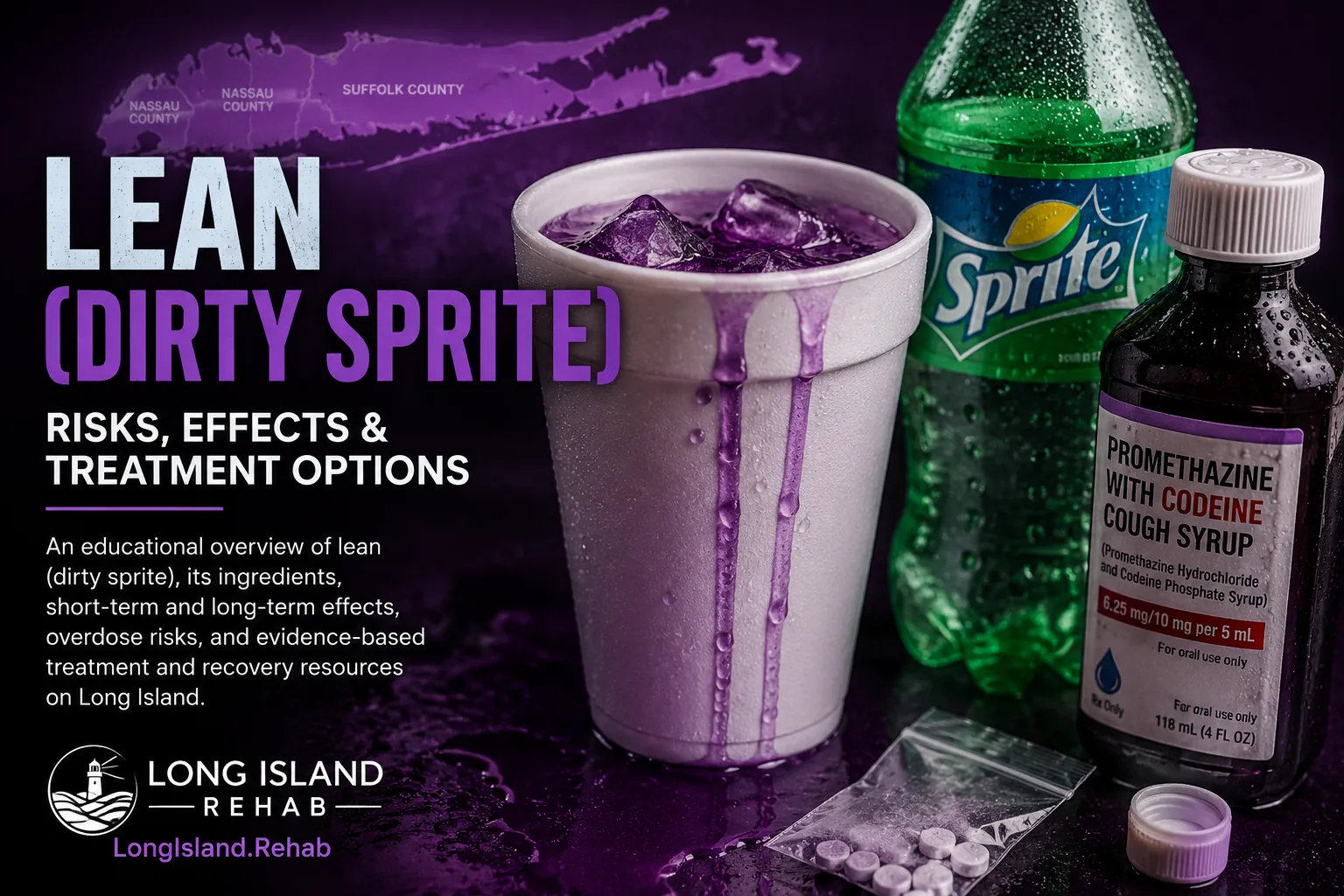
Lean is prescription cough syrup containing codeine (an opioid) and promethazine (a sedating antihistamine), mixed with soda — classically Sprite — and often hard candy. "Dirty sprite," "purple drank," and "sizzurp" are all names for the same drink. Because it combines two central nervous system depressants, lean can slow breathing to dangerous levels, and regular use produces opioid dependence and withdrawal.
Lean at a Glance
| Attribute | Detail |
|---|---|
| Active drugs | Codeine (opioid) + promethazine (sedating antihistamine) |
| Street names | Lean, dirty sprite, purple drank, sizzurp, drank, barre, Texas tea |
| Controlled substance | Schedule V (United States) — prescription only |
| Onset | Roughly 30–45 minutes when swallowed; delayed onset encourages dangerous re-dosing |
| Primary acute risk | Respiratory depression — worsened by alcohol, benzodiazepines, or other sedatives |
| Chronic risks | Opioid dependence, withdrawal, dental damage, constipation, blackouts |
| Counterfeit risk | Street "syrup" may contain unknown sedatives or other opioids, including fentanyl in reported cases |
| Who's most affected | Teens and young adults — ages 13–21 account for roughly two-thirds of users in national survey data |
What Does "Dirty Sprite" Mean in Drug Slang?
In drug slang, "dirty sprite" means Sprite mixed with prescription codeine-promethazine cough syrup — Sprite that has been "dirtied." The term spread widely through hip-hop, including rapper Future's Dirty Sprite mixtape and DS2 album. Related terms parents and professionals should recognize:
- Lean: the most common name, from the slumped posture of heavy sedation.
- Purple drank / purple tonic: from the purple color of some brand syrups.
- Sizzurp / syrup / drank / barre / Texas tea: Houston-origin terms from the 1990s scene where the drink first became culturally prominent.
- Double cup: the stacked styrofoam cups associated with drinking lean — a visual signal on social media, not just a serving style.
Note the ambiguity: "Dirty Sprite" is also used as a cannabis strain name by some commercial breeders. Context — cups, syrup bottles, soda, candy — points to the drink.
Why the Codeine-Promethazine Combination Is Dangerous
Codeine is an opioid that suppresses the brainstem's drive to breathe. Promethazine is a first-generation antihistamine with strong sedative effects that intensify codeine's respiratory depression. FDA labeling for these products carries boxed warnings against combining them with alcohol, benzodiazepines, or other sedatives — yet lean is very often consumed with exactly those substances. What looks like someone "sleeping it off" can be progressive respiratory depression.
The sweet soda-and-candy flavor adds a second danger: it masks the medicine taste, so users — especially first-time teen users — consume dangerous amounts before the full effect arrives.
Fake Syrup and Fentanyl Risk on Long Island
Legitimate promethazine-codeine syrup has become harder to obtain as manufacturers discontinued brand products and prescribers tightened up. Street demand didn't disappear — supply just went counterfeit. Bottles sold through social media, delivery apps, and in-person contacts across Nassau and Suffolk may be diluted, dyed, mixed with other sedatives, or spiked with different opioids entirely, including fentanyl in reported cases. As with counterfeit pressed pills, the label tells you nothing about the contents.
Warning signs of a possible overdose after drinking lean include:
- Extreme sleepiness or inability to wake
- Slow, shallow, or stopped breathing
- Blue or gray lips
- Gurgling or choking sounds
- Pinpoint pupils
- Loss of consciousness
If any of these appear, treat it as an opioid overdose: call 911, place the person on their side, and administer naloxone (Narcan) if available. Naloxone will not hurt someone who did not take an opioid, and it can save the life of someone who unknowingly did. In New York, naloxone is free through OASAS-registered Opioid Overdose Prevention Programs.
Signs of Lean Use Parents and Partners Notice First
- Styrofoam double cups, empty soda bottles with syrup residue, missing prescription cough syrup
- Unexplained heavy drowsiness, slurred speech, "nodding off" at odd times
- Slowed movements and the characteristic leaning or swaying posture
- Constipation complaints, dental problems, weight change
- Purple-stained cups or clothing; candy wrappers paired with soda in unusual quantities
- Lean references in music, group chats, or social posts — double-cup imagery, "drank," "po up"
When Lean Use Becomes Dependence
Codeine is an opioid, and regular use — even "weekends only" — produces tolerance and physical dependence. Dependence becomes a substance use disorder when patterns emerge: drinking lean alone or daily, escalating amounts, mixing with alcohol or benzodiazepines, buying syrup from nonmedical sources, failed attempts to stop, or continued use despite school, work, or family consequences. National survey data show lean use concentrates in ages 13–21, and early opioid exposure raises the risk of later opioid use disorder — which is why early intervention matters more with lean than its "soda drink" image suggests.
Lean Withdrawal
Stopping after regular use produces classic opioid withdrawal: anxiety, restlessness, muscle aches, sweating, nausea, diarrhea, insomnia, and strong cravings. Symptoms typically start within 8–24 hours of the last dose, peak around days 1–3, and mostly resolve within 4–10 days. Codeine withdrawal is rarely medically dangerous on its own — but many people who use lean also drink or take benzodiazepines, and those withdrawal syndromes can be dangerous. A medical assessment before quitting is the safe first step, and anyone using daily should treat withdrawal as a medical event rather than a willpower test.
Detox and Treatment Options in Nassau and Suffolk
Treatment for lean/codeine dependence follows the standard opioid pathway, scaled to severity:
- Medical assessment — quantifying use, screening for alcohol or benzodiazepine co-dependence, and checking overall health.
- Medically supervised withdrawal management — outpatient or inpatient depending on severity and co-used substances.
- Medication-assisted treatment (MAT) — buprenorphine-based options are effective for moderate-to-severe codeine dependence.
- Outpatient and intensive outpatient (IOP) programs — structure, counseling, and family involvement, which is especially important for teen and young-adult patients.
- Recovery support — relapse-prevention planning, peer support, and school/family coordination. Learn more about evidence-based treatment options. Learn more about addiction treatment resources.
If you're not sure which level of care fits, that's exactly what our peer advocates help families figure out — including insurance verification and placement across Nassau and Suffolk programs.
When to Seek Help
Reach out for professional help if someone:
- Cannot stop or reduce lean use
- Experiences withdrawal symptoms between uses
- Needs more over time to feel the same effect
- Mixes lean with alcohol, benzodiazepines, or other substances
- Buys syrup online or from nonmedical sources
- Has blackouts, memory gaps, or escalating sedation
- Is a teenager using at any level
Emergency Warning Signs
Call 911 immediately if someone has:
- Slow, shallow, or stopped breathing
- Blue or gray lips
- Cannot be awakened
- Seizures
- Severe confusion
- Loss of consciousness
- Suspected fentanyl exposure
If naloxone is available, give it during a suspected opioid overdose while waiting for emergency responders.
Popular Questions About Lean
| Question | Quick Answer |
|---|---|
| What is dirty sprite? | Sprite mixed with prescription codeine-promethazine cough syrup — the same drink as lean. |
| Is lean addictive? | Yes. Codeine is an opioid; regular use causes dependence and withdrawal. |
| Can you overdose on lean? | Yes — lean overdose is opioid overdose. Naloxone and 911 are the response. |
| Is lean illegal? | The syrup is a Schedule V controlled substance; possession without a prescription is illegal. |
| Can fake syrup contain fentanyl? | Yes. Counterfeit "syrup" may contain unknown sedatives or other opioids, including fentanyl in reported cases. |
Related Guides
On LongIsland.rehab:
- How Long Does Benzodiazepine Withdrawal Last? — relevant when lean is combined with Xanax or other benzos.
- Xanax Bars on Long Island: Risks, Fake Pills, Withdrawal & Treatment Options — the counterfeit-pill parallel to fake syrup.
Educational References (ISSUP)
The following professional publications on lean (dirty sprite) and codeine withdrawal are hosted by the International Society of Substance Use Professionals (ISSUP) and are provided here as educational references only:
- What Is Lean (Dirty Sprite)? Risks, Slang & Treatment
- Codeine Withdrawal: Symptoms, Timeline & Treatment
This article is for educational and informational purposes only and does not constitute medical advice or a diagnosis. If someone may be overdosing, call 911 immediately and administer naloxone if available. If you or a loved one may be struggling with substance use, consult a qualified professional.